The sea, industry and Latin, brought together in a system of symbols.
I / THE SEAL
A club emblem
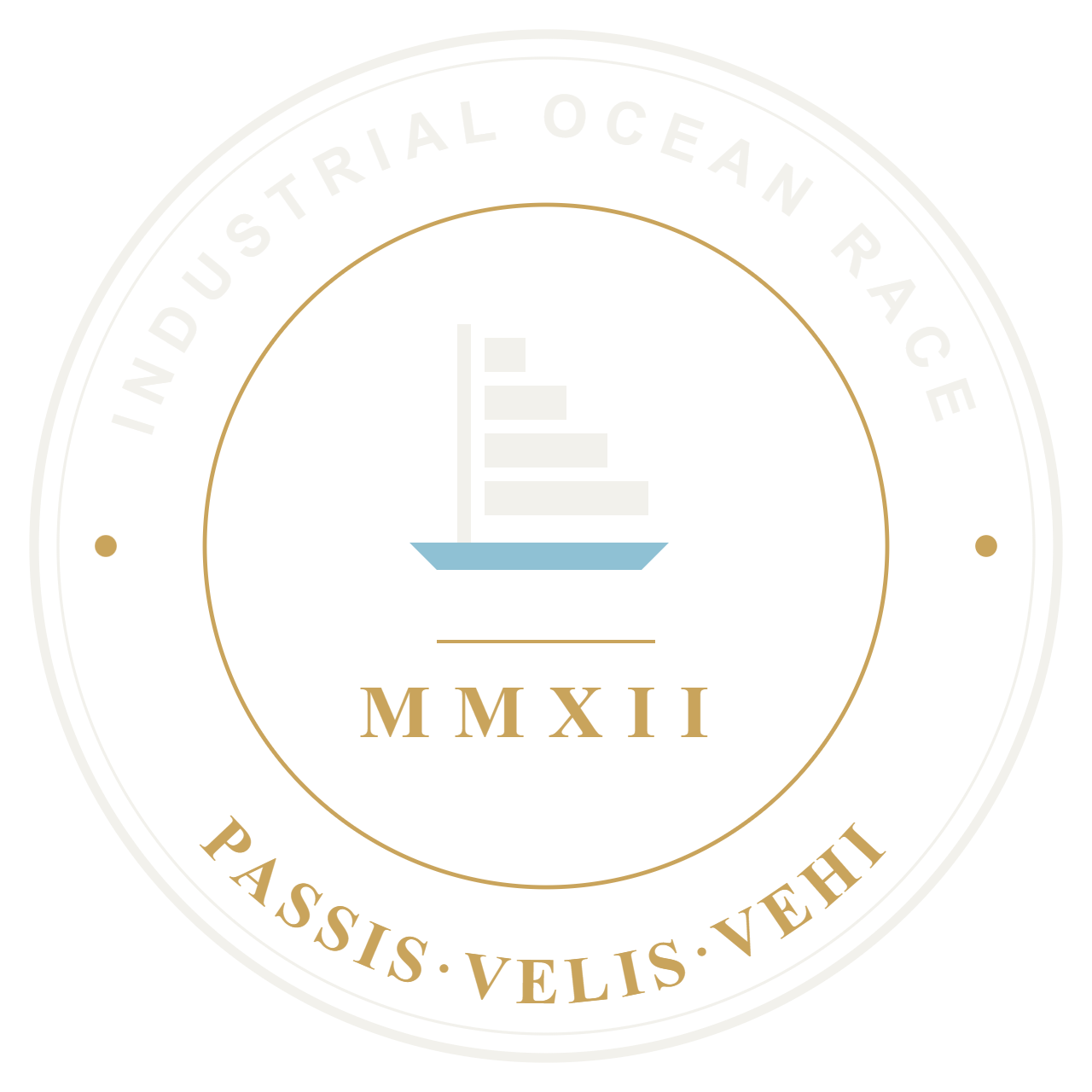
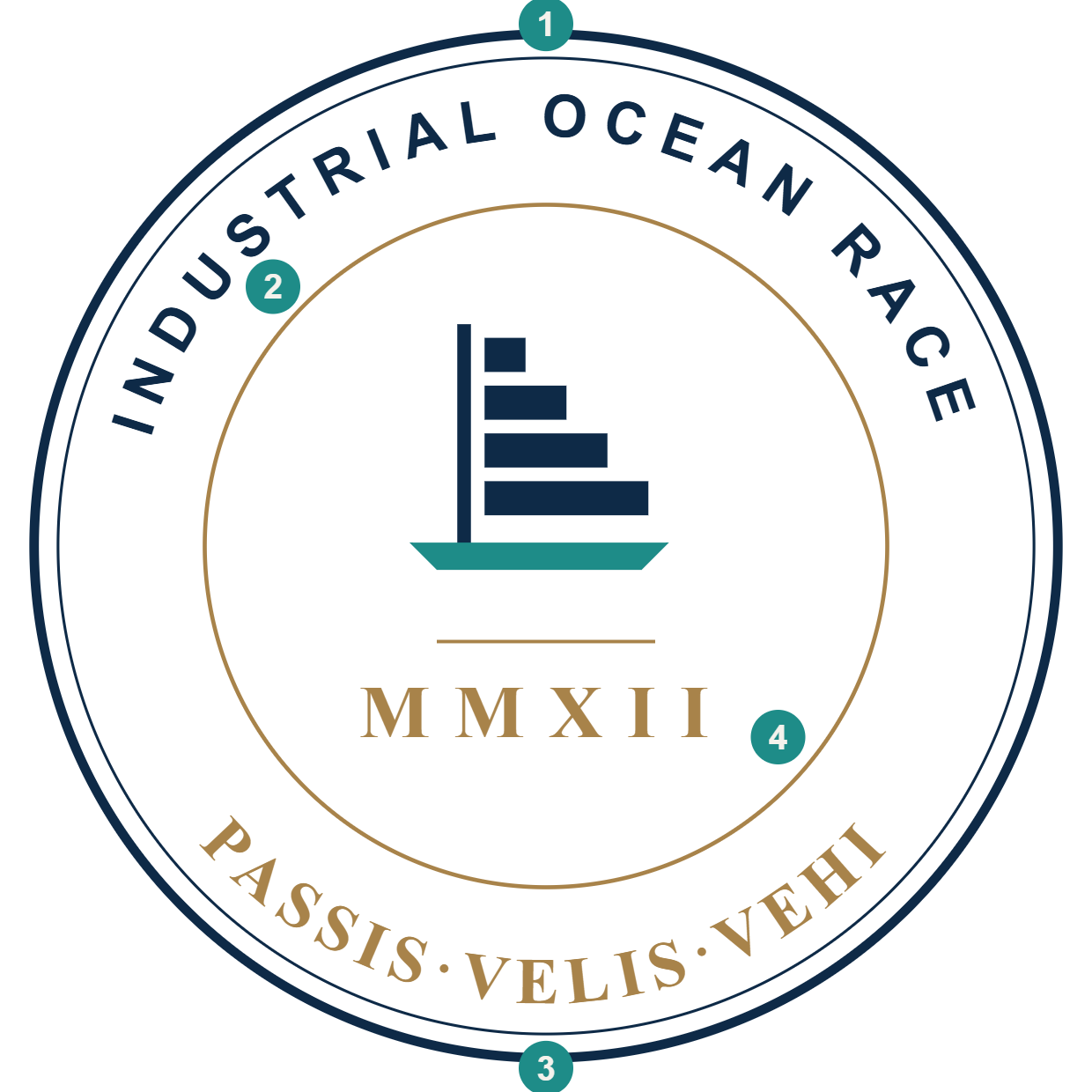
Inspired by traditional yacht club seals. The double ring marks a boundary and a sense of belonging: those inside are on board.
The name. Industrial comes first: the regatta grew out of industry.
The yacht. A mast, a sail made of four bands and a hull on the water.
The motto. The name says who we are. The motto says how we sail.
MMXII. 2012, the first regatta, Tenerife.
II / THE YACHT
One sail.
Two readings.
Rolled steel
The bands of the sail resemble sheets of rolled steel. Each stands for an industry or a participating company. Separately, they are steel. Together, they form a sail catching the same wind.
One mast: many industries, a shared course. The teal hull represents the team and the regatta, bringing industry and the sea together.
II / THE SIGNAL
On the same wavelength
Turn the sail through a quarter rotation and it becomes a mobile signal indicator. Four bars out of four mean a full connection.
For a regatta bringing together digital leaders, the message is direct: the connection holds even on the open ocean, and the participants are on the same wavelength.
III / THE GEAR AND THE WIND ROSE
A mechanism
with a sense of direction
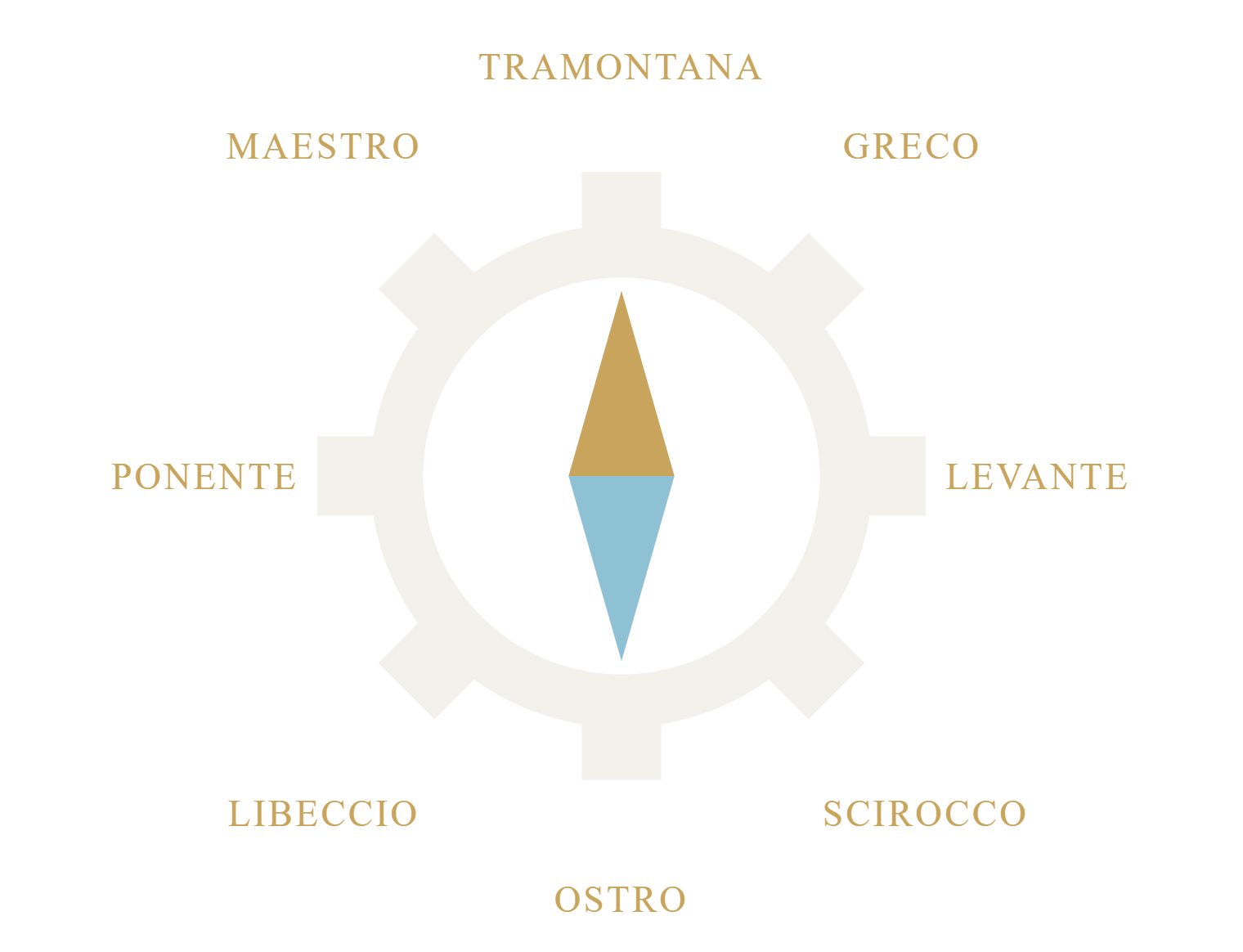
Eight winds. Medieval Mediterranean sailors named eight winds, from Tramontana to Maestro. Each wind has a corresponding gear tooth.
Brass north. Ships’ compasses were fitted with brass because it does not disturb the needle. North represents the goal.
The gear transmits effort: one person’s experience moves everyone forward.
III / THE ARC OF GEOGRAPHY
The geography of the emblem
Only half of the gear is visible on the business card. The other half extends beyond the edge: the journey continues.
ATLANTIC — Tenerife, 2012 and 2019. Where it all began.
CARIBBEAN — Antigua, 2013; Saint Martin, 2014, 2018, 2020.
MEDITERRANEAN — the birthplace of the wind rose and its eight names.
ARABIAN — the western Indian Ocean, Seychelles, 2016.
ANDAMAN — Phuket, 2017.
IV / THE MOTTO
PASSIS·VELIS·VEHI
“To sail with sails unfurled”
PASSIS — “unfurled”. From pando, “to spread out”. Aulus Gellius explained it as early as the second century.
VELIS — “with sails”. Velum refers both to the canvas and to sailing under it.
VEHI — “to be carried”. The wind carries the vessel, and the crew raises the sails.
CICERO / TUSCULAN DISPUTATIONS, I, 119 / 45 BC
Under full sail
Quo utinam velis passis pervehi liceat! Sin reflantibus ventis reiciemur, tamen eodem paulo tardius referamur necesse est.
“If only we could reach it under full sail! But if opposing winds drive us back, we must still arrive at the same place, only a little later.”
For IOR: give it your all and remember that headwinds happen. A yacht tacks and still reaches the mark.
V / THE YEAR AND THE TYPEFACE
MMXII
2012, the first regatta, Tenerife. The year is written in Roman numerals, as on foundation stones and ships.
The motto and year in the brand emblem use Cinzel. Its forms draw on first-century Roman capital inscriptions, such as those on Trajan’s Column. Cicero’s Latin is set in letters inspired by his era.
VI / COLOURS
Each colour is a material
Deep blue
The open ocean and the night watch.
Teal
Coastal waters: the hull and the course lines.
Brass
Marine fittings and the compass: north, the motto and the year.
Polished steel
Rolled steel, machinery and the metal token.
THE LEGEND IN ONE PARAGRAPH
A shared course
The IOR sail is made of four bands of steel. They represent industries catching the same wind and, at the same time, a full signal indicator. The eight-toothed gear echoes the eight winds of the traditional wind rose, while the brass needle always points north. The motto comes from Cicero: sail at full strength and reach your goal even against the wind. The first regatta took place in MMXII.